
Last update November 30, 2002 at 04:20 UTC.
[Solar and geomagnetic data
- last 4 weeks (updated daily)]
[Solar wind and electron
fluence charts (updated daily)]
[Solar cycles 21-23 (last
update November 2, 2002)]
[Solar cycles 1-20]
[Graphical comparison of
cycles 21, 22 and 23 (last update November 2, 2002)]
[Graphical comparison of
cycles 10, 13, 17, 20 and 23 (last update November 2, 2002)]
[Historical solar and geomagnetic
data charts 1954-2002 (last update October 13, 2002)]
[Archived reports (last update November 24, 2002)]
The geomagnetic field was quiet to active on November 29. Solar wind speed ranged between 465 and 602 km/sec. The onset of a coronal stream was observed at ACE at 05:30 UTC.
Solar flare activity was low. Solar flux was 141.3, the planetary A
index was 14 (STAR Ap - based on the mean of three hour ap indices: 14.4).
Three hour interval K indices: 33423433 (planetary), 32422332 (Boulder).
The background x-ray flux is at the class B5 level.
At midnight there were 7 spotted regions on the visible disk, 2 of which have not yet been numbered. Only 1 C class event was recorded during the day.
Region 10200 decayed and was spotless by early evening.
Region 10202 lost a few of its small spots and was quiet.
Region 10203 decayed into spotless plage.
Region 10204 decayed and had lost all but one spot by midnight..
Region 10205 was quiet and stable.
Region 10207 was mostly unchanged in penumbral area, however, the positive and negative polarity areas drifted apart as
the region simplified. An occasional minor M class flare may be possible. Flare: C2.9 at
04:33 UTC.
New region 10208 rotated into view at the northeast limb.
Spotted regions not yet numbered by SEC:
[S38] A new region rotated into view at the southeast limb. Location at midnight: S19E74.
[S39] A new region emerged in the southwest quadrant. Location at midnight: S10W63.
November 27-29: No obviously geoeffective CMEs noted.
Coronal hole history (starting late October 2002)
A recurrent trans equatorial coronal hole was in a geoeffective position on November 27-28.
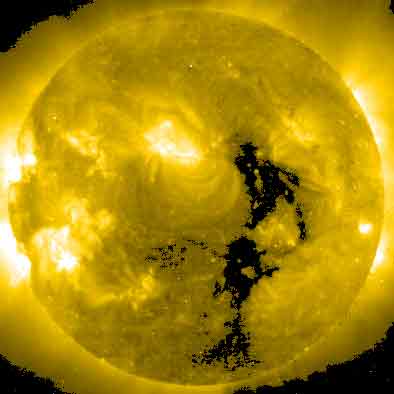
Processed SOHO EIT 284 image at 01:06 UTC on November 30. The black areas on the solar disk are coronal holes.
The geomagnetic field is expected to be unsettled to minor storm on November 30 and quiet to active on December 1 under the influence of a coronal stream. Quiet to unsettled is likely on December 2. Long distance medium wave (AM) band propagation along east-west paths over high and upper middle latitudes is poor to very poor.
| Coronal holes (1) | Coronal mass ejections (2) | M and X class flares (3) |
 |
|
|
1) Effects from a coronal hole could reach Earth within the
next 5 days.
2) Material from a CME is likely to impact Earth within 96 hours.
3) There is a possibility of either M or X class flares within the next 48
hours.
Green: 0-20% probability, Yellow: 20-60% probability, Red: 60-100% probability.
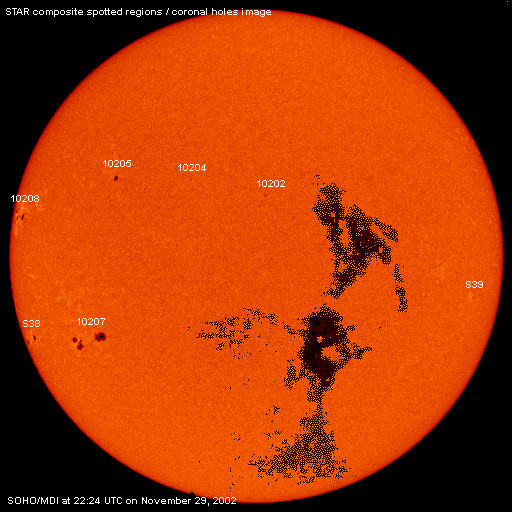
Composite image based on a SOHO/MDI continuum image and overlaid by a coronal hole image. Region numbering has been included.
Data for all numbered solar regions according to the Solar Region Summary provided by SEC/NOAA. Comments are my own, as is the STAR spot count (spots observed at or just prior to midnight) and data for regions not numbered by SEC or where SEC has observed no spots.
| Solar region | Date numbered | SEC spot count |
STAR spot count |
Location at midnight | Area | Classification | Comment |
|---|---|---|---|---|---|---|---|
| 10200 | 2002.11.20 | 2 | S02W50 | 0000 | AXX | now spotless | |
| 10202 | 2002.11.24 | 9 | 6 | N13W01 | 0020 | CRO | |
| 10203 | 2002.11.26 | 1 | N10E29 | 0010 | HRX | now spotless | |
| 10204 | 2002.11.27 | 4 | 1 | N18E14 | 0010 | BXO |
classification was AXX at midnight |
| 10205 | 2002.11.27 | 1 | 1 | N19E36 | 0050 | HSX | |
| 10206 | 2002.11.27 | S27E17 | plage | ||||
| 10207 | 2002.11.27 | 14 | 15 | S19E44 | 0430 | EAO | |
| 10208 | 2002.11.29 | 6 | 8 | N09E75 | 0100 | DSO |
area was near 0150 at midnight, classification was DAO |
| S38 | visible on 2002.11.29 |
3 | S19E74 | 0080 | DSO | ||
| S39 | emerged on 2002.11.29 |
2 | S10W63 | 0020 | HRX | ||
| Total spot count: | 37 | 36 | |||||
| SSN: | 107 | 106 | |||||
| Month | Average solar flux at Earth |
International sunspot number | Smoothed sunspot number |
|---|---|---|---|
| 2000.04 | 184.2 | 125.5 | 120.8 cycle 23 sunspot max. |
| 2000.07 | 202.3 | 170.1 | 119.8 |
| 2001.10 | 207.6 | 125.5 | 114.0 (-0.1) |
| 2001.11 | 210.6 | 106.5 | 115.5 (+1.5) |
| 2001.12 | 235.1 | 132.2 | 114.6 (-0.9) |
| 2002.01 | 226.6 | 114.1 | 113.5 (-1.1) |
| 2002.02 | 205.0 | 107.4 | 114.7 (+1.2) |
| 2002.03 | 179.5 | 98.4 | 113.4 (-1.3) |
| 2002.04 | 189.8 | 120.7 | 110.5 (-2.9) |
| 2002.05 | 178.4 | 120.8 | (109.0 predicted, -1-5) |
| 2002.06 | 148.7 | 88.3 | (107.0 predicted, -2.0) |
| 2002.07 | 173.5 | 99.9 | (103.6 predicted, -3.4) |
| 2002.08 | 183.6 | 116.4 | (100.2 predicted, -3.4) |
| 2002.09 | 175.8 | 109.3 | (96.4 predicted, -4.8) |
| 2002.10 | 167.0 | 97.5 | (92.3 predicted, -4.1) |
| 2002.11 | 169.5 (1) | 155.9 (2) | (87.0 predicted, -5.3) |
1) Running average based on the daily 20:00 UT observed solar flux value at 2800
MHz.
2) Unofficial, accumulated value based on the Boulder (SEC/NOAA) sunspot number. The official
international sunspot number is typically 25-45% less.
This report has been prepared by Jan Alvestad. It is based partly on my own observations and interpretations, and partly on data from sources noted in solar links. Comments and suggestions are always welcome.
| [DX-Listeners' Club] [DX News] |