Last update December 22, 2002 at 04:15 UTC.
[Solar and geomagnetic data
- last 4 weeks (updated daily)]
[Solar wind and electron
fluence charts (updated daily)]
[Solar cycles 21-23 (last
update December 2, 2002)]
[Solar cycles 1-20]
[Graphical comparison of
cycles 21, 22 and 23 (last update December 2, 2002)]
[Graphical comparison of
cycles 10, 13, 17, 20 and 23 (last update December 2, 2002)]
[Historical solar and geomagnetic
data charts 1954-2002 (last update October 13, 2002)]
[Archived reports (last update December 16, 2002)]
The geomagnetic field was quiet to minor storm on December 21 with several magnetometers recording major storm conditions during the 03-06h UTC interval. Solar wind speed ranged between 380 and 519 km/sec, slowly decreasing all day.
Solar flare activity was low. Solar flux was 183.9, the planetary A
index was 18 (STAR Ap - based on the mean of three hour ap indices: 19.5).
Three hour interval K indices: 45323322 (planetary), 45212331 (Boulder).
The background x-ray flux is at the class B8 level.
At midnight there were 7 spotted regions on the visible disk. A total of 8 C class flares were recorded during the day. A large filament eruption in the northern hemisphere was associated with a C2.1 event peaking just before 01h UTC.
An M1.2 long duration event peaking at 02:49 UTC on December 22 had its origin in a filament eruption at a location between regions 10223 and 10229 (in approximately the same area as the M2.7 event on Dec.19). A type II sweep was associated with this event, as was a fairly large CME. This CME is currently a partial halo CME with most of the ejected material observed off of the northwest limb and the north pole. The CME could be geoeffective but a more definitive evaluation of that will have to wait for a few hours.
Region 10223 decayed further. At the current rate of decay this region will become spotless before rotating over the
northwest limb on Dec.25.
Region 10224 developed quickly when new flux emerged in the southern part of the trailing spot section. A weak
magnetic delta structure has formed and the region could soon produce an M class flare. Flares: C4.6
at 04:53 and C1.6 at 09:51 UTC.
Region 10226 decayed quickly in the leading and trailing spot sections and slowly in the intermediate spot section. The
region lost its magnetic delta configuration and is now much less active than it has been over the past several days. An M class
flare is still possible. Flares: C2.2/1F at 04:41, C1.6 at 09:51 and C1.0 at 19:10 UTC.
Region 10227 decayed and was spotless before noon.
Region 10228 decayed into spotless plage
Region 10229 decayed in all parts of the region losing many small spots.
Region 10230 developed slowly in the trailing spot section which now has a weak magnetic delta structure. An M class
flare is possible. Flare: C1.3 at 23:40 UTC.
Region 10231 did not change much and was quiet.
New region 10232 emerged in the northeast quadrant on Dec.20 and was numbered the next day. Slow development was observed
during the day.
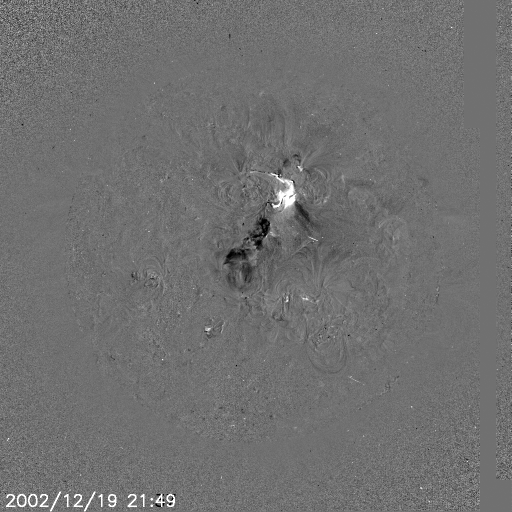
December 19: A full halo CME was observed in LASCO C3 images from about 08h UTC. The source of this CME is uncertain and may have been backsided. Another full halo CME was observed late in the day after an M2.7 event in region 10229. This CME (see this EIT 195 difference image) was first observed in LASCO C2 images at 22:06 UTC off of the northwest limb and will likely reach Earth before 18h UTC on December 22. Unsettled to minor geomagnetic storm conditions are possible.
December 20: No obviously geoeffective CMEs observed.
December 21: A large filament eruption at high latitudes in the northern hemisphere early in the day was associated with a partial halo CME observed off of the northeast and northwest limbs as well as the north pole. This CME is probably not geoeffective.
Coronal hole history (since late October 2002)
Compare today's report with the situation one solar rotation ago: 28
days ago
27 days ago 26 days ago
A trans equatorial coronal hole will likely reach a geoeffective position at the central meridian on December 24-25.
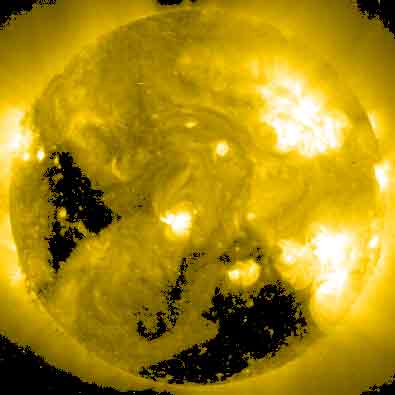
Processed SOHO EIT 284 image at 01:06 UTC on December 22. Any black areas on the solar disk are likely coronal holes.
The geomagnetic field is expected to be quiet to minor storm on December 22 and quiet to active on December 23. Long distance medium wave (AM) band propagation along east-west paths over high and upper middle latitudes is poor to very poor.
| Coronal holes (1) | Coronal mass ejections (2) | M and X class flares (3) |
 |
 |
|
1) Effects from a coronal hole could reach Earth within the
next 5 days.
2) Material from a CME is likely to impact Earth within 96 hours.
3) There is a possibility of either M or X class flares within the next 48
hours.
Green: 0-20% probability, Yellow: 20-60% probability, Red: 60-100% probability.

Composite image based on a SOHO/MDI continuum image and overlaid by a coronal hole image. Region numbering has been included. Compare to the previous day image.
Data for all numbered solar regions according to the Solar Region Summary provided by SEC/NOAA. Comments are my own, as is the STAR spot count (spots observed at or inside a few hours before midnight) and data for regions not numbered by SEC or where SEC has observed no spots.
| Solar region | Date numbered | SEC spot count |
STAR spot count |
Location at midnight | Area | Classification | Comment |
|---|---|---|---|---|---|---|---|
| 10223 | 2002.12.12 | 5 | 3 | N25W45 | 0050 | CSO | |
| 10224 | 2002.12.12 | 13 | 26 | S14W45 | 0070 | DSO |
beta-gamma-delta
classification was DAI at midnight, area 0170 |
| 10225 | 2002.12.13 | 2 | N17W46 | 0020 | AXX | now spotless | |
| 10226 | 2002.12.13 | 29 | 25 | S28W54 | 0510 | FKC |
beta-gamma
classification was FKI at midnight, area 0400 |
| 10227 | 2002.12.13 | 1 | N07W76 | 0040 | HSX |
now spotless, area was at most 0010 early in the day |
|
| 10228 | 2002.12.14 | S14W26 | plage | ||||
| 10229 | 2002.12.14 | 23 | 14 | N19W29 | 0140 | EAO | beta-gamma |
| 10230 | 2002.12.17 | 27 | 32 | S08E06 | 0300 | EAI | beta-gamma-delta |
| 10231 | 2002.12.19 | 6 | 9 | S25W13 | 0030 | CAO |
area was 0050 at midnight, classification DAO |
| 10232 | 2002.12.21 | 3 | 4 | N13W08 | 0020 | DAO | formerly region S58 |
| Total spot count: | 109 | 113 | |||||
| SSN: | 199 | 183 | |||||
| Month | Average solar flux at Earth |
International sunspot number | Smoothed sunspot number |
|---|---|---|---|
| 2000.04 | 184.2 | 125.5 | 120.8 cycle 23 sunspot max. |
| 2000.07 | 202.3 | 170.1 | 119.8 |
| 2001.11 | 210.6 | 106.5 | 115.5 (+1.5) |
| 2001.12 | 235.1 | 132.2 | 114.6 (-0.9) |
| 2002.01 | 226.6 | 114.1 | 113.5 (-1.1) |
| 2002.02 | 205.0 | 107.4 | 114.7 (+1.2) |
| 2002.03 | 179.5 | 98.4 | 113.4 (-1.3) |
| 2002.04 | 189.8 | 120.7 | 110.5 (-2.9) |
| 2002.05 | 178.4 | 120.8 | 108.8 (-1.7) |
| 2002.06 | 148.7 | 88.3 | (106.4 predicted, -2.4) |
| 2002.07 | 173.5 | 99.9 | (102.8 predicted, -3.6) |
| 2002.08 | 183.6 | 116.4 | (99.6 predicted, -3.2) |
| 2002.09 | 175.8 | 109.3 | (96.6 predicted, -3.0) |
| 2002.10 | 167.0 | 97.5 | (93.1 predicted, -3.5) |
| 2002.11 | 168.7 | 95.0 | (87.8 predicted, -5.3) |
| 2002.12 | 169.4 (1) | 116.9 (2) | (83.5 predicted, -4.3) |
1) Running average based on the daily 20:00 UT observed solar flux value at 2800
MHz.
2) Unofficial, accumulated value based on the Boulder (SEC/NOAA) sunspot number. The official
international sunspot number is typically 25-45% less.
This report has been prepared by Jan Alvestad. It is based partly on my own observations and interpretations, and partly on data from sources noted in solar links. Comments and suggestions are always welcome.
| [DX-Listeners' Club] [DX News] |