
Last update issued on October 18, 2003 at 04:00 UTC.
[Solar and geomagnetic data - last month (updated daily)]
[Solar wind and electron fluence charts (updated daily)]
[Solar cycles 21-23 (last update October 4, 2003)]
[Solar cycles 1-20]
[Graphical comparison of cycles 21, 22 and 23 (last update October 4, 2003)]
[Graphical comparison of cycles 2, 10, 13, 17, 20 and 23 (last update October
4, 2003)]
[Historical solar and geomagnetic data charts 1954-2003 (last update October 15, 2003)]
[Archived reports (last update October 15, 2003)]
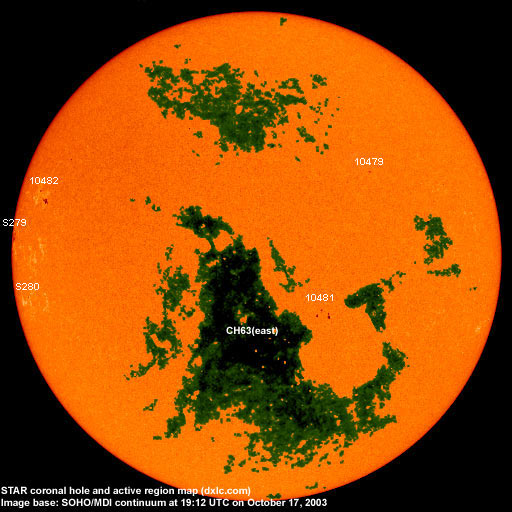
The geomagnetic field was unsettled to minor storm on October 17. Solar wind speed ranged between 488 and 583 km/sec under the influence of a high speed stream from coronal hole CH63.
Solar flux measured at 20h UTC on 2.8 GHz was 98.8. The planetary A
index was 31 (STAR Ap - based on the mean of three hour interval ap indices: 32.1).
Three hour interval K indices: 45554333 (planetary), 4554233 (Boulder).
The background x-ray flux is at the class B2 level.
At midnight there were 5 spotted regions on the visible disk. Solar flare activity was very low.
Region 10479 reemerged with a few spots. Slow decay was observed late in the day.
New region 10481 emerged in the southwest quadrant early in the day. Quick development was observed initially, later in the
day the region appeared to be decaying with loss of penumbral area in the trailing spots.
New region 10482 emerged at the northeast limb early in the day.
Spotted regions not numbered by NOAA/SEC:
[S279] This region rotated into view at the northeast limb and may be capable of C class flaring. Location at midnight:
N05E80.
[S280] A small region rotated into view at the southeast limb on October 17. Location at midnight: S08E68.
October 15-17: No potentially geoeffective CMEs observed.
Coronal hole history (since late October 2002)
Compare today's report with the situation one solar rotation ago: 28
days ago 27 days ago 26 days ago
A recurrent trans equatorial hole (CH63) was in a geoeffective position on October 12-18. CH63 has become much smaller over the last rotation, losing most of its extension into the northern hemisphere. CH63 has merged with what was CH59 in the southeast.

Processed SOHO/EIT 284 image at 16:36 UTC on October 17. The darkest areas on the solar disk are likely coronal holes.
The geomagnetic field is expected to be unsettled to minor storm on October 18-21 due to a high speed stream from coronal hole CH63.
Long distance low frequency (below 2 MHz) propagation along east-west paths over high and upper middle latitudes is very poor. Propagation along north-south paths is poor. [Trans Atlantic propagation conditions are currently monitored every night on 1470 kHz. Dominant stations tonight: Radio Cristal del Uruguay and Radio Vibración (Venezuela)].
| Coronal holes (1) | Coronal mass ejections (2) | M and X class flares (3) |
 |
|
|
1) Effects from a coronal hole could reach Earth within the next 5 days.
2) Material from a CME is likely to impact Earth within 96 hours.
3) There is a possibility of either M or X class flares within the next 48 hours.
Green: 0-20% probability, Yellow: 20-60% probability, Red: 60-100% probability.
Compare to the previous day's image.
Data for all numbered solar regions according to the Solar Region Summary provided by NOAA/SEC. Comments are my own, as is the STAR spot count (spots observed at or inside a few hours before midnight) and data for regions not numbered by SEC or where SEC has observed no spots.
| Solar region | Date numbered | SEC spot count |
STAR spot count |
Location at midnight | Area | Classification | Comment |
|---|---|---|---|---|---|---|---|
| 10477 | 2003.10.06 | 3 | S15W78 | 0040 | HSX | spotless | |
| 10479 | 2003.10.10 | 2 | 2 | N24W31 | 0010 | HAX |
classification was HRX at midnight |
| 10480 | 2003.10.15 | 2 | N21W51 | 0010 | AXX | spotless | |
| 10481 | 2003.10.17 | 5 | 5 | S08W17 | 0030 | CAO |
classification was DAO at midnight, area 0060 |
| 10482 | 2003.10.17 | 4 | 6 | N16E62 | 0060 | CSO |
classification was DAO at midnight, area 0090 |
| S273 | emerged on 2003.10.08 |
N13W60 | plage | ||||
| S279 | visible on 2003.10.17 |
7 | N05E80 | 0120 | DAO | ||
| S280 | visible on 2003.10.17 |
1 | S08E68 | 0000 | AXX | ||
| Total spot count: | 16 | 21 | |||||
| SSN: | 66 | 71 | |||||
| Month | Average solar flux at Earth |
International sunspot number | Smoothed sunspot number |
|---|---|---|---|
| 2000.04 | 184.2 | 125.5 | 120.8 cycle 23 sunspot max. |
| 2000.07 | 202.3 | 170.1 | 119.8 |
| 2001.12 | 235.1 | 132.2 | 114.6 (-0.9) |
| 2002.09 | 175.8 | 109.6 | 94.6 (-4.1) |
| 2002.10 | 167.0 | 97.5 | 90.5 (-4.1) |
| 2002.11 | 168.7 | 95.5 | 85.2 (-5.3) |
| 2002.12 | 157.2 | 80.8 | 82.0 (-3.2) |
| 2003.01 | 144.0 | 79.7 | 80.9 (-1.1) |
| 2003.02 | 124.5 | 46.0 | 78.5 (-2.4) |
| 2003.03 | 131.4 | 61.1 | 74.1 (-4.4) |
| 2003.04 | 126.4 | 60.0 | (69.6 predicted, -4.5) |
| 2003.05 | 115.7 | 55.2 | (65.3 predicted, -4.3) |
| 2003.06 | 129.3 | 77.4 | (61.5 predicted, -3.8) |
| 2003.07 | 127.7 | 85.0 | (58.0 predicted, -3.5) |
| 2003.08 | 122.1 | 72.7 | (55.0 predicted, -3.0) |
| 2003.09 | 112.2 | 48.8 | (53.0 predicted, -2.0) |
| 2003.10 | 108.9 (1) | 37.5 (2) | (50.3 predicted, -2.7) |
1) Running average based on the daily 20:00 UTC observed solar flux value at 2800 MHz.
2) Unofficial, accumulated value based on the Boulder (NOAA/SEC) sunspot number. The official international sunspot number is typically
30-50% less.
This report has been prepared by Jan Alvestad. It is based partly on my own observations and analysis, and partly on data from sources noted in solar links. All time references are to the UTC day. Comments and suggestions are always welcome.
| [DX-Listeners' Club] |